Tooth Friendly Super Bowl Snacks

 
Healthy Super Bowl Snacks


Are you ready for the Big Game?  A Super Bowl get-together demands super snacks but not at the expense of your teeth.  That’s why we’ve put together a few tasty game day snacking ideas with healthy ingredients.  Of course, these are snacks, and none of them are perfect.  Regardless of what you eat, don’t forget to brush!


Spicy Jalapeño Dip


Super Bowl Jalapeno Ranch Dip


What’s in it:

1 16 oz.  tub low-fat sour cream
1 packet of Hidden Valley Ranch (or other brand) Fiesta Dip
1 jalapeno, seeded and cubed

How it’s done:

Combine all ingredients in a blender and blend thoroughly.
Serve  the dip with raw vegetables such as carrots and celery.

What makes it tooth friendly:

This dip with a kick will make your veggies disappear.  Raw veggies require lots of chewing which stimulates and promotes healthy gums.  Carrots contain beta-carotene that your body uses to create vitamin A which works to build strong teeth.  The sour cream in this dip gives your teeth a boost of Calcium which also helps to keep your teeth strong.


Hummus with Cucumber


SUper Bowl Hummus


What’s in it:

1/4 cup lemon juice
2 (15 ounce) cans chickpeas, one drained, one with liquid
4 tablespoons sesame seeds
2 tablespoons olive oil
1 garlic clove, peeled
1 teaspoon cumin
1 teaspoon salt
1 teaspoon pepper
1 cucumber
1/2 tablespoon parsley

How it’s done:

Place all ingredients in a blender in the order listed except for the cucumber.
Blend for approximately 1 to 1 and a half minutes, pulsing as necessary.
Slice up the cucumber into thick pieces for dipping.
Place hummus in serving bowl and drizzle additional olive oil on top with some parsley for garnish.

What makes it tooth friendly:

Protein rich chickpeas don’t contain any saturated fat or cholesterol, making hummus a good choice for your overall health.  Chickpeas are also rich in folic acid, which keeps your mouth healthy by promoting cell growth throughout your body.  As to the cucumbers, not only are they a healthy alternative to chips, but they are rich in vitamins B and C and have even been shown to help freshen breath and naturally whiten teeth!


The Party Standard: The Meat & Cheese Tray


Super Bowl Healthy Snacks


What’s in it:
This party tray is a cheese buffet with Gouda, White Cheddar, Havarti and Chipotle Jack.
Shaped like a football field on a kale turf, it includes red grapes, whole wheat crackers and summer sausage.

What makes it tooth friendly:
The cheese on the sidelines plays quarterback in this party tray.  Cheese is a tooth powerhouse with tons of tooth strengthening calcium and a protein called casein which is amazingly effective in protecting the surface of your teeth. One note about the crackers, however.  We chose whole wheat crackers for their beneficial fiber, but all crackers can stick to teeth and promote bacteria growth.  Again, just be sure to brush after the game!


Baked Cheese Roll

 

Super Bowl Healthy Cheese Dip


What’s in it:
Goat Cheese Log
Grape or Olive Oil
1 small carton of Grape Tomatoes (sliced)
Basil Pesto
Balsamic Glaze
French Bread or Crackers

How it’s done:
Preheat oven to 350°
In a jelly roll pan or small casserole dish, add approximately 1/4 inch of grape or olive oil.
Place goat cheese in the pan and cover with pesto, then grape tomatoes.
Bake for 20-30 minutes, remove from the oven and drizzle with balsamic glaze.
Serve with French bread or your favorite healthy crackers.

What makes it tooth friendly:
If cheese made from cow’s milk is a powerhouse, goat cheese is a touchdown.  It contains more protein and calcium than cow’s milk cheese and yet has less fat and calories per serving.  The higher calcium of goat cheese means even more protection for your teeth.


Healthy 7-Layer Dip


Super Bowl Healthy 7 Layer Dip


What’s in it:
3 Cups black beans
6 Oz. Greek yogurt (plain)
1 Cup shredded cheese
1 small can sliced black olives

Guacamole:
2 avocados
2 Tbsp. chopped cilantro
1 chopped chive
Juice from 1/2 lime
1 clove minced garlic
1/2 seeded and diced Jalapeño

Pico De Gallo:
2 small diced tomatoes
2 Tbsp. chopped cilantro
Juice from 1/2 lime
1/2 seeded and diced Jalapeño
1 chopped chive

How it’s done:
Mix together all ingredients for the pico de gallo.
In a separate bowl, mix the ingredients for the guacamole layer.
The ingredients can be added in the following order (starting at the bottom): beans, yogurt, cheese, olives, guacamole, pico de gallo.

What makes it tooth friendly:
This dish has it all and it’s a great update of what is usually a calorie dense snack.  While tomato and citrus juices can be tough on your teeth because of their high acidity, the cheese and Greek yogurt help to balance that out.  Plus, this dish is high in vitamins E, A and C, which are all essential for a healthy mouth.  Choosing celery or another vegetable over chips would make this an even better choice for your teeth.


Remember, regardless of what you choose to snack on during the Super Bowl, be sure to brush twice a day for two minutes each time!  What will you be snacking on during the Big Game this year? Comment below and let us know!


Thumbsucking and Your Child’s Teeth

How to stop thumbsucking
 

Thumbsucking is a very common habit for young children and is usually nothing to worry about.  However, it can be a concern when the habit continues or when it begins to cause problems with normal oral development.  Here’s everything you need to know about thumbsucking and what can be done to help your child stop.

Is thumbsucking normal?

Thumbsucking is common and normal. In fact, it is such a natural behavior that ultrasounds often reveal it before birth.  Babies natural reflexes cause them to suck on any object placed in their mouths.  This behavior can provide comfort and soothe anxious nerves, which is why thumbsucking can develop into a habit long after infancy. It’s estimated that 1/3 of all children will suck their thumbs during infancy.  Positive emotional development and peer pressure generally end thumbsucking by kindergarten, but some children will continue the habit which can lead to dental problems.


When is it a problem?

If thumbsucking continues after permanent teeth come in or especially in cases of excessively hard sucking, dental problems can occur.  Your child’s palate (the roof of the mouth) may become arched causing what’s known as an “Open Bite”.  It may also cause front teeth to be pushed forward, causing bite and speech problems.  Many older children who still suck their thumbs may have trouble making “S” sounds or sounds requiring the tongue to touch the front teeth.  Some children develop chapped skin or nail problems on the thumb or finger being sucked.  After age 5, or when permanent teeth are starting to erupt, the child should be encouraged to stop.


How can I help my child stop thumbsucking?

Children usually stop sucking their thumb during their toddler years, but some will continue to use the behavior as a comfort mechanism.  We’ve found that the best methods to curb thumbsucking are based on positive reinforcement.  Here are a few ideas you might consider:

  • A first-step may be to simply ignore the behavior, especially if it is part of a power struggle with your child or it is being used to gain attention.  Some experts suggest a “one month moratorium” on discussing the subject before moving on to other methods.
  • Use praise when your child isn’t sucking his or her thumb, never scold them when they do.
  • Try positive reinforcement such as a sticker chart or other reward system.
  • Seek out the possible causes of anxiety and work to alleviate the reasons for thumbsucking.
  • Some children suck their thumbs from boredom.  Try engaging your child in a fun activity.
  • Allow older children to pick a reward for not sucking their thumb.
  • Mention the behavior at your child’s next appointment and allow us to offer some positive motivation.
  • As a last resort, place a bandage or sock on the child’s hand at night to discourage thumbsucking while sleeping.

Resolutions for a Cavity-Free Year

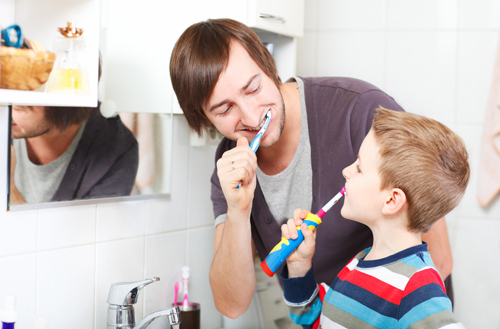
Brushing teeth together 454x300
Did you know that the most common chronic childhood disease is tooth decay?  According to the Centers for Disease Control and Prevention, nearly one out of every five children in the US has an untreated cavity.  More than 51 million school hours are lost every year because of dental problems.  Moreover, nearly 100% of cavities are preventable.  Want a cavity free year?  Following these five simple steps can keep you and your kids on the right path to a healthy mouth:

1. Catch up on dental visits.

Start the year off right by setting up an appointment and taking care of issues you may have been avoiding.  Time or finances can result in missed checkups, but putting off needed exams or dental work often causes problems to become more costly, more time consuming and more painful.

2. Commit to brushing 2min2x.

Brushing for two minutes, twice each day is basic to staying cavity free.  Brushing at the same time each day, as part of your regular routine can help develop a daily habit of oral care.  Consider brushing with your children so they can see an example of good oral hygiene and will be motivated to care for their own teeth.  Because brushing for a full two minutes can be a challenge for young children, the ADA has created fun videos that are exactly two minutes long.  You can find them on the 2Min2X website.

3. Consider using mouthwash.

Studies continually show that mouthwash can dramatically reduce cavities when used alongside regular brushing. Choose a mouthwash with the American Dental Association (ADA) seal of acceptance and make using it part of your daily routine.

4. Check that you are getting the proper amount of fluoride.

Fluoride is a natural mineral that has been shown to dramatically reduce cavities.  You may not realize it, but most of the water coming from faucets in the U.S. is fluoridated.  Unfortunately, bottled water usually doesn’t contain fluoride, so kids and adults that exclusively drink bottled water may be missing valuable anti-cavity benefits.  Switch to tap water this year. You could save a plastic bottle from the trash and possibly your teeth from a cavity.

5. Clean between teeth by flossing.

Surprisingly, a survey from Delta Dental revealed that 43 percent of parents said their children’s teeth are never flossed.  Additionally, the ADA reports that one in ten US adults neglect flossing as well.  Why not start a new habit this year and begin flossing regularly?  Flossing helps to reach the places that a toothbrush simply cannot go and it’s one of the best ways to prevent gum disease.

Cavities are preventable.  This could be a banner year for your teeth simply by following these simple steps.  Please leave a comment below if you have any questions or give us a call to set up an appointment today!

Solutions to 5 Common Causes of Bad Breath

Causes of bad breath
 

Bad breath, or halitosis is a common problem for people of all ages.  While some bad breath is normal, such as what’s caused by certain foods, bad breath may also be a symptom of something greater.  Here are five common causes of bad breath and their solutions:

Cause: Smelly food

Foods with a strong odor before you eat them are likely to have a strong odor afterwards.

Solution:  Chewing sugar-free gum is likely to help cure bad breath caused by smelly foods such as garlic.  You might also try eating something minty – the real reason that your meal often comes with parsley.  Also, one trick is a small dab of mustard, which is said to kill the smell quickly.

Cause: Medication

Sometimes certain medications (such as antihistamines) can cause you to produce less saliva, making your mouth dry.  Bacteria that often gets washed away by saliva is then left to reproduce and leave a foul odor.

Solution: Aside from changing your medication, sugar-free chewing gum may help your mouth by increasing saliva.  Drinking more water will also rid your mouth of some of the bacteria that causes bad breath.

Cause: Dairy

Generally, dairy products are good for your teeth.  But they can also cause bad breath because bacteria love to feed on their high levels of amino acids.

Solution:  Keep eating dairy; it’s really good for your teeth! But be sure to brush and floss regularly as well.  Rinsing your mouth with water following meals may also help keep bad breath away.

Cause: Mouth breathing

Breathing through your mouth, especially when congested from a cold, can cause bad breath because it dries out your mouth.  But if you regularly breathe primarily through your mouth while sleeping it may be caused by a larger problem.

Solution: Seeing a physician for sleep apnea, snoring or asthma may be in order.

Cause: Gum disease & plaque

Your mouth may smell because it’s unhealthy.  Bacteria allowed to grow between the teeth and around your gums may be causing damage that needs to be treated.

Solution:  Aside from regular brushing and flossing, staying on top of regular dental check-ups is essential.  Is your family caught up?  Why not give us a call and schedule an appointment today?


Brushing Right After Eating May Harm Your Teeth

Brushing after meals can harm teeth
 

One of the most surprising facts of caring for your teeth is that you should actually wait at least an hour after eating before brushing.  In fact, brushing right after a meal may actually do more damage than good.

Here’s why you shouldn’t brush your teeth immediately after eating.

Your tooth enamel, the hardest substance in your body, works to protect your teeth.  But acids created by food can wear away that protective enamel.  During meals, that acid level gets elevated and your teeth are at their weakest state.

Your body has a natural way to correct the high acid levels in your mouth and return it to a proper pH level.  It’s the work of saliva to naturally wash away food particles and give your enamel the balance it needs to continue its protective work.

Brushing right after meals can mean that you are actually attacking your teeth! Even soft-bristled toothbrushes can be highly abrasive when enamel is already weakened by high acid levels.  It’s best to let saliva do its job after you eat.  You can help the process along by rinsing your mouth with water or chewing sugarless gum which will help to increase the amount of saliva in your mouth even more.

But don’t forget to brush!

Wait at least an hour for your mouth to recover from the acid assault.  And don’t forget to brush at least two times a day and for two minutes each time.

Chewing Gum: Facts, Fun and Your Teeth

Chewing ghum and your teeth
 

The History of Chewing Gum

Chewing gum has a long and fascinating history.  For 5,000 years humans have enjoyed chewing on bark tar, resin from the mastic tree and other plants and grasses.  American Indians made a form of gum from spruce tree sap.  But for most of our history, we have used chicle, a natural gum made from trees in a similar way that natural rubber is produced.  Political reform in Guatemala during the 1950’s meant that big chewing gum companies like Wrigley no longer had access to chicle, so by the mid 1960’s most gum was produced from a butadiene-based synthetic rubber.

Will swallowed gum harm me?

Gum made from synthetic rubber may not sound too appetizing, however gum is generally harmless to your body.  Have you ever heard people claim that swallowed gum will stay in your stomach for “seven years” or that it will “stick to your lungs”? While it is usually a good idea to simply spit out used gum, only a very large quantity of gum or gum that is swallowed with food or foreign objects poses any risk to blocking your intestinal tract.  Your teeth, however, may be another story.

Gum and your teeth.

Because many types of gum contain sugar as a primary ingredient, frequent gum use can be harmful to your teeth.  Sugar feeds the bacteria that cause plaque, which in turn hammers away at the enamel on your teeth.  A lot of sugary gum means that bacteria are getting a lot of food to grow which can lead to a lot more plaque.  Additionally, while many people chew gum for fresh breath, the end result of extra bacteria (caused by the extra sugar) is even more bad breath.

What about sugar-free gum?

Studies have shown that sugar-free chewing gum is actually good for your teeth.  When you chew, saliva is produced that helps to wash away food particles.  In fact, saliva is your body’s first natural defense against the bacteria in your mouth.  Further, some sugar free gum is made with a natural sugar substitute called xylitol that has been shown to reduce cavities and protect teeth.   Even with xylitol, however, chewing gum can never replace brushing and flossing.  Sugar-free gum can be a good alternative for people who love to chew gum but also want to protect their teeth.

The Good, the Bad, the Ugly: A Look at the Best and Worst Candy for Your Teeth

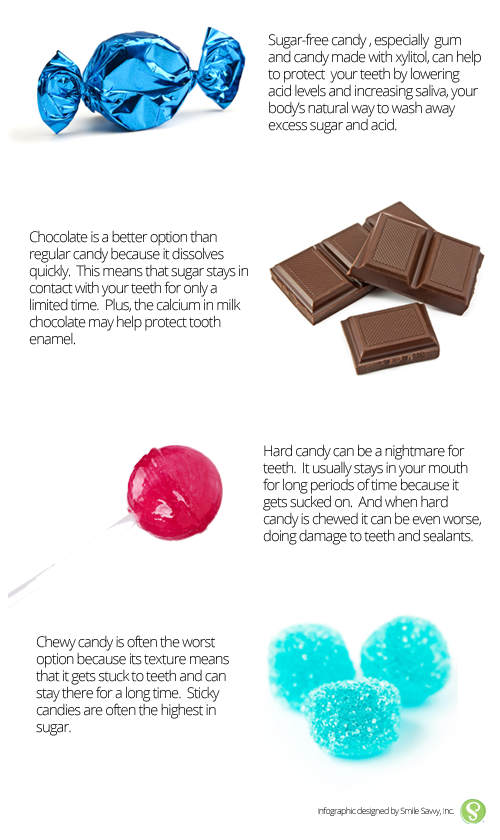
Not all candy is created equal in terms of its potential damage to your teeth.  The sugar in candy feeds the bacteria that cause plaque. So the amount of sugar a candy contains along with the length of time it sits on teeth often determines how destructive it is.  This infographic looks at several options, from the best to the worst.
 

The Best and the worst candy for your teeth

Help For Those Finding it Difficult to Floss

Help with flossing

According to the American Dental Association, nearly 20% of Americans never floss.  Many people invariably view flossing as optional which causes it to become one of the most frequently neglected parts of any oral care routine.  But as much of a plaque fighter that your toothbrush is, it simply cannot reach all the tight spots between your teeth.  Only floss is adept at getting to all the areas where bacteria hide.  Here are a few ideas for those of us who find it difficult to floss:

Learn how to floss.

Flossing can be confusing for those who don’t do it regularly.  The good news is that it’s not hard to learn.  The American Dental Association’s website has very good instructions on how to floss and has even put together a one page .pdf to teach you how!  You can download it here.

If you find flossing difficult, try floss holders.

Whether from large fingers or a lack of dexterity, some people simply have difficulty with the mechanics of flossing even after learning to do it the right way.  Floss holders have become increasingly popular and are a great alternative for anyone who might find flossing difficult.  Plus, holders made specifically for smaller mouths are great for children or adults helping with their child’s daily oral care.

Consider waxed floss.

Occasionally floss can become frayed, shredded or broken.  This is often caused by teeth that are very close together. You might consider using waxed floss or floss made from polytetrafluoroethylene, a substance that is extremely slick.  Shredded floss can also be caused by teeth that are broken or have cavities.  If this is the case, don’t put off your next appointment!

Make flossing a priority.

Instead of making flossing a “once-in-a-while” task, consider establishing a routine of flossing.  This will help you get in the habit of truly taking care of your teeth and gums.

It’s important to understand that flossing is just as important as brushing, that it isn’t optional and that it’s not too late to develop a healthy habit.


Ideas For A Candy Free Halloween

What if you want to hand out tooth friendly Halloween treats but don’t want to get on the “trick” list?  We believe that a candy free Halloween can be even more fun than one coated in sugar.  Here are 5 ideas to help you be the most popular house on the street while saving tiny teeth from cavities one trick-or-treater at a time.­

Candy Free Halloween Treats

Give a “prize” instead of a treat.

Retailers that sell party favors and supplies are a great place to find prizes that you can hand out to kids.  These small trinkets last long after the candy has been eaten and will be remembered much longer as well.


Candy Free Halloween Play Dough

Help kids get creative with clay!

Multi-packs of mini play dough containers are available to purchase or you can even make your own.  You could put small batches of homemade play dough in plastic baggies with a quick note explaining that the dough is for play and not food.


Candy Free Halloween Ideas Glow Sticks

Keep kids safe with glow sticks!

Glow sticks are available at really low prices at craft and discount stores.  Kids love glow sticks (and so do we!)


Candy Free Halloween Stickers

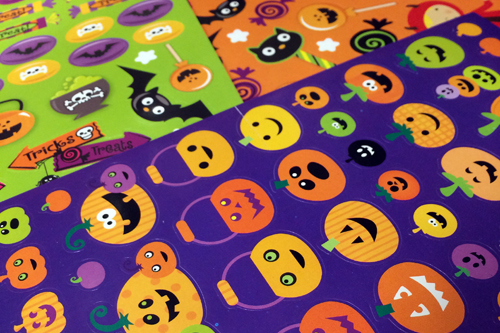
Give fun Halloween stickers.

Who doesn’t love a cool sticker?  If you have a variety, you can let kids choose their own design that they can then save for later or wear while trick-or-treating.


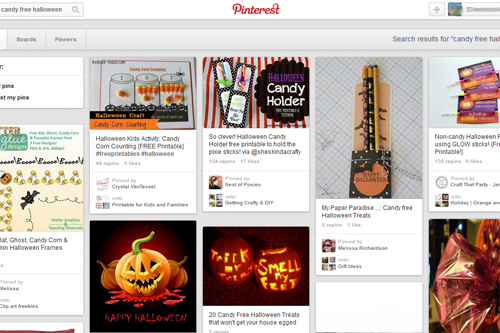
candy_free_halloween Pinterest Ideas


Get awesome ideas on Pinterest.

A quick search on Pinterest reveals a TON of ideas for a candy free Halloween.  You can find craft ideas, inexpensive gifts and handouts that will make every child who comes to your door smile.  While your at it, check out our Pinterest boards for even more dental health ideas!


Have more ideas?  We would love to hear from you.  Leave us a comment below!


Why Do Pirates Have Bad Teeth? ­­­­

Pirates and Bad Teeth
 

Have you ever noticed that pirates all seem to have bad teeth?  Have you ever wondered why? Probably not, but in honor of “International Speak Like a Pirate Day” we thought we would share why pirates have such a poor reputation for terrible chompers!  And the answers might also give us some helpful ideas for taking care of our own oral health.

Scurvy was a serious problem.

Scurvy is more than just a pirate insult.  It’s a disease caused by a lack of vitamin C and it can cause severely weakened and receding gums.  Pirates were often the victims of scurvy because they spent months at a time on the open seas with no access to fresh fruits and vegetables.  It wasn’t uncommon for pirates to have missing teeth due to poor gums.   What does this mean for us?  Eating a healthy diet with plenty of fresh fruits and vegetables can help us avoid looking like scurvy pirates!

They didn’t brush their teeth.

It wasn’t until 1938 that the modern toothbrush was invented.  Until then, if pirates cleaned their teeth at all it would have been with a “chew stick” which was less than effective at keeping teeth clean and plaque at bay.  Thankfully, today we have a lot of tooth-brushing options, the best being soft bristled and made to fit the size of your particular mouth.  Brushing for at least two minutes, twice a day can help you keep your teeth ship-shape.

Cavities were left untreated.

It’s hard to make oral care a priority when you’re sailing the ocean and looking for innocent ships to plunder!  Modern technology has made a tremendous difference in early cavity detection, but pirates would have had to rely on pain as an indicator that something was wrong with their teeth.  By the time a cavity is severely hurting, however, it means that tooth decay has grown so severe that enamel and dentin have been worn away exposing sensitive nerves located in the pulp of your tooth.  While we may not be able to enjoy the thrills of the open sea, we’re pretty thankful that regular dental visits can keep bacterial invaders at bay.

There were no real dentists!

In times past, dental services were practiced by people who had many trades.  A pirate “dentist” may very well have also served as the ship’s cook, boatswain or master gunner.  And while they may have tried their best at helping with dental care, being good with a cutlass doesn’t necessarily mean a pirate would make a good dentist!   We love what we do, and we’re focused on proving the best dental care possible in a caring and relaxed environment.  Pirates may not have had access to professional dental care, but you do, and we hope to see you soon, matey!


Latest News from Children's Dental Specialties